Pages

Saturday, 18 February 2012

Without Judy Blume, I’d know nothing about life


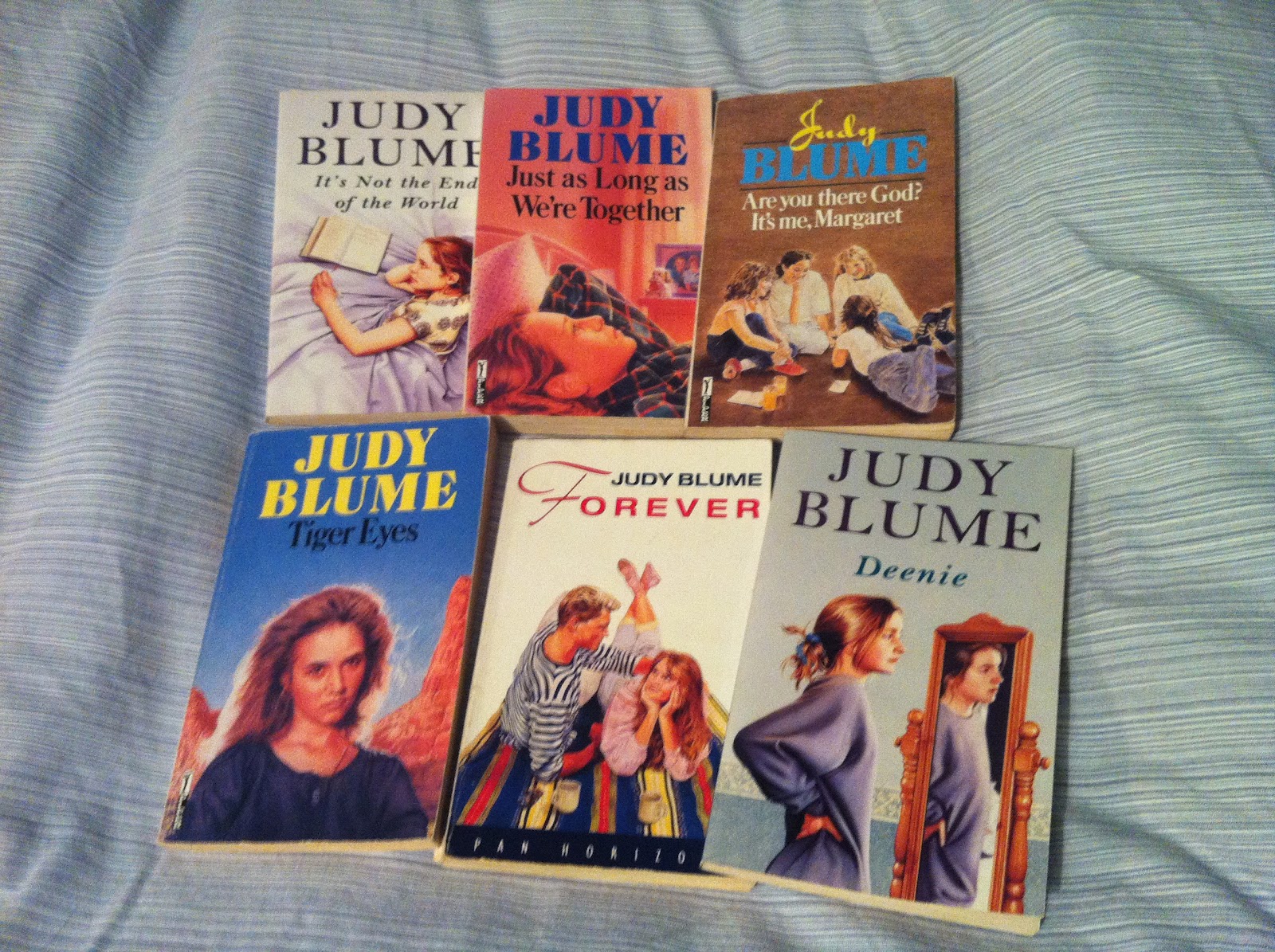
My much-loved Judy Blume collection
There is no other teen novelist who had such an impact on me as Judy Blume. And based on some Twitter conversations last night, I’m not alone in my enduring respect and love for Judy.  (Would it be too familiar to call her Auntie Judy?)
This came about after my mum yesterday produced a box of my old books. Among the battered copies of Jill Murphy’s Worst Witch series, Snoopy novels, and Adrian Mole diaries (held together with peeling Sellotape) were a handful of extremely tatty and well-thumbed Judy Blume novels.
It was like meeting up with old friends, ones who had held my hand through those confusing pre-pubescent years and early adolescence. There was Deenie, who endured a crippling back brace before facing the fear of her first period. And here’s Margaret, who confides in God about her worries about periods and her parents’ marriage. Don’t forget Stephanie, who had to handle the problem of juggling two best friends. And then there was Karen, who felt so alone after her parents got divorced; and Davey who was grieving for her father. But never forget Katherine and Michael, whose love was not to last, err, forever.
It surprised me to find just the six tatty paperbacks. Where were all the others? Judy wrote prolifically in the 1970s and 1980s and I’d read every one of her books. And then I realised that while I’d devoured everything Judy wrote, the act of owning books was certainly not taken for granted back when I was 11/12 and at the height of my Judy reading. This was before I had a Saturday job and my own money, so any books I owned came from birthday or Christmas presents or book tokens. Everything else was found in the school or public libraries, or borrowed and swapped with friends. In school holidays, we’d even post paperbacks to each other. There’s something very pleasing about remembering this early absorption in reading, and for it to be a shared pleasure – one that was not ordered by teachers but that was entirely self-generated, and one that was (at times) irritating to teachers and parents, who knew there were sometimes controversial topics in Judy’s books (periods, masturbation, bullying, racial abuse, parental divorce, the Holocaust, teenage sex…). 
Aged 11, I spent a year diligently scribbling in my Judy Blume Memory Book.
Needless to say, it is extremely embarrassing to read now.
I really don’t think it would be overstating the matter to say that Judy contributed to the bulk of my early education about puberty and growing up. Remember, I was reading Judy’s books in 1989/1990, while attending a convent school staffed by joyless Belgian nuns, and the internet was but a twinkle in someone’s eye. Pretty much all I knew about puberty came from the solitary school visit by the Dr Whites nurse: our class was not told the reason why our timetabled lesson was cancelled and we were being shepherded into the formal assembly hall, where a middle-aged nurse proceeded to show us some confusing watercolour pictures of cross-sections of the female body (minus head or legs), before issuing us all with a bag of leaflets and Dr Whites samples. Couple this with the solitary lesson about periods from our biology teacher, which involved her getting a Tampax out of its wrapper, and putting it in a glass of water to show us how big it would get. But at no point telling us why we would need such a scary looking thing, or even where we should put it. Honestly, I can only hope that sex education in British schools has progressed a lot in the past 22 years. And don’t get me started on the sex education video we were shown (in the school library, which was sealed off with ‘Do Not Enter’ signs, already making us aware that sex was a shameful act, a fact that was aided by the TV being positioned underneath a crucifix), which was filmed in the 1970s and involved some extremely hairy, naked people playing volleyball on a beach, and a starchy male scientist in a studio talking incomprehensibly about things like ‘penises’ and ‘vaginas’ (what were they?!).
So, thank heavens for Judy Blume. Thank heavens she wrote Are You There God? It’s Me Margaret and Deenie, to explain about periods and that they were perfectly normal, but that it was OK to be a bit confused about the whole thing. And thank heavens she wrote her books in such an accessible way that made you sure that here, finally, was an adult who understood what it was you needed to know, and whom your friends also read.
Woo! Judy wrote to me in February 1990...
I chose to overlook that it was a photocopied form letter.
But Judy didn’t just teach me about growing up, she also made me aware of a whole world outside of the tiny Somerset village I grew up in. Judy’s books were all set in her homeland of America. To 11-year-old me, there seemed as much chance of me going to the moon as to somewhere as exotic as America. After all, this was a country with a whole other dialogue! Judy’s books were peppered with words and phrases I didn’t understand, and needed to find out the meaning of. What were ‘cooties’? What was ‘the den’? What was Scotch tape? There were so many examples that made America seem way more glamorous than my provincial English existence. Why didn’t my school have a ‘homeroom’? Why didn’t we have a schoolbus? Or Halloween parades? What the heck was a ‘Y’? Looking back now, it’s terrifying to know that all the Jewish references were also alien to me – with my Catholic education and small-town English upbringing. It’s embarrassing to admit that. At my school, we had no knowledge of any religions outside of Church of England or Catholicism. As far as we knew, there were no other options. And since WW2 wasn’t covered in history classes, there was no need for us to know about Judaism. This alone is a terrifying lack in 1980s/1990s schooling.
What’s my favourite Judy book? It’s Deenie, the first book of Judy’s I read, and probably the one I’ve read more than any others (first accessed from the school library – but removed after the nuns discovered it had references to periods and masturbation). But Are You There God? It’s Me Margaret holds a strong place in my affections (a Christmas present, and a book I fondly remember while lying on the sofa with Neighbours on). And it’s impossible to overlook the significance of Forever on my young mind (bought with Christmas book tokens in WH Smith). I’m sure that book is responsible for many generations of women who remain unable to snigger when they hear the name Ralph – maybe Forever is single-handedly responsible for the decline in popularity of the name Ralph?!
Has Judy been sainted yet for her services to education? Because she should be. The very fact that so many of her books were deemed controversial or even placed on banned lists (here’s an article by Judy that explains more about this) is testament to the fact that her books were honest and true accounts of real topics that patriarchal society feared it would be damaging for young girls to know about.
Thank you, Judy, for writing all those important books, and for filling in the many glaring gaps in my education where my schools failed me. And thank you for introducing me to America, a land I still think of as romantic and exciting.
--
Here’s a powerful article in The Tablet about Judy’s Holocaust novel, Starring Sally J Freedman As Herself.
And here’s a Huffington Post article about Judy’s most controversial books.

HG Wells and the suffrage novel


First published in 1909, Ann Veronica is HG Wells’ novel addressing his support of women winning the right to vote and thereby gain their independence from men. And it’s a strange one.
Our heroine Vee is a 21-year-old, middle-class science scholar who lives with her widowed father and spinster aunt in Suburbia. She dreams of escaping her father’s overbearing control over her, and of taking up with her Bohemian friends… who have introduced her to the idea of women’s suffrage.
Ann Veronica is a book in two parts. In the first half of the novel, Vee is painted as a naïve but impassioned young woman who is determined to get what she wants by any means. HG Wells creates her as a malleable vehicle for demonstrating to his readers how suffocated women are without the vote, and the subsequent right to live independently of fathers or husbands.
Yet the second half of the novel, as has been widely agreed in reviews, descends into a tedious romance bearing little relation to the first half, and causing the reader to care little for what scrape Vee has now found herself in, and whether she can win yet more people round to her manipulative way of thinking.
This was a curious book to read as I work my way through as many suffrage novels as I can manage, but I’m not sure HG Wells put as much time and thought into this as he did with his better known books. There’s every cynical possibility that Ann Veronica was simply an outing for him to express his (supportive) views about the enfranchisement of women.

Sunday, 12 February 2012

Iron Jawed Angels – a film about US suffrage


There are many oddities about this 2004 HBO film, which looks like it was made for TV. The most glaring of which is the jarring music, which at best can be described as sub-standard ‘90s trip hop: whatever you call it, it’s achingly out of place on a period film set in the late 1910s that focuses on the American fight for suffrage.
Iron Jawed Angels manages a double casting whammy with both Hilary Swank and Angelica Houston in strong roles, supported well by Frances O’Connor and Julia Ormond. The film is a biopic of Alice Paul (played by Swank), who led the campaign in America to ensure all women were granted the vote, and not just women in certain states.
While the story is fascinating, Iron Jawed Angels is by no means a good film! It is an extremely strangely constructed and produced film.
Hilary Swank is a fantastic actress, but she seems oddly cast as Alice Paul – her face and voice are too contemporary for the role. Similarly, the other suffragettes in her party look like 21st Century women playing dress-up in 19th Century costumes – which, in essence, they are.
And then there is the bizarre use of editing techniques: cross fades and jump cuts are painfully out of step in a period film, but they’re used ad nauseum here. And the mise-en-scene of the costumes is nothing more than grating – the actresses are dressed in glamorous 1910s outfits that seem far removed from clothes that women of their class and income would have worn. And the screen time and narrative pressure placed on Alice Paul’s blinkin’ pink hat are so over emphasised that it becomes excruciating. It’s certainly not subtle, as mise-en-scene should be.
And the sound? I found it hard to detach from the music, which was comical in its inappropriateness, and extremely distracting from the rest of the film. About half way through, I contemplated muting the DVD and switching the subtitles on in order to simply make the noise stop.
In short – as a film about the American suffrage movement, Iron Jawed Angels is (mostly) well acted and extremely interesting. But as a film in its own right, it is poorly directed, unsympathetically edited and horrifically soundtracked. I can’t think what would ever make me watch it again.

(As a footnote: I’ve heard rumours that the team behind Made In Dagenham are currently in the early stages of producing a film about the British suffrage campaign, which will be written by Abi Morgan – who scripted The Iron Lady and The Hour. More news on this as and when I hear it.)

Tuesday, 7 February 2012

Homeland - and the rise of female leads in TV dramas


In recent years, TV viewers have enjoyed several crime dramas with strong female leads.

Borgen, The Killing, Prime Suspect, The Closer… OK, the list starts to run a little thin here. But I’m pleased to say we can now add Homeland to the countdown, which is starting its UK airing on February 19, over on Channel 4.

Following it’s initial season in the US, Homeland has scored two Golden Globe wins – including Best Actress in a TV Series for the female lead Claire Danes, who plays CIA agent Carrie Mathison. A second season has been promised for the autumn.

Loosely based on Gideon Raff's Israeli TV series Prisoners of War, it centres on an American soldier, Sgt Nicholas Brody, (Damian Lewis) taken prisoner during the invasion of Iraq in 2003. Left for dead, Brody miraculously returns to the US after years in captivity. CIA agent Carrie Mathison (Claire Danes) becomes convinced that the intelligence that led to his rescue was a set-up, and that this national hero may be connected to an Al-Qaeda plot to be carried out on American soil.
You can also throw in Carrie’s own psychological demons after her experiences working in Afghanistan, and the fact she is bipolar – a condition she keeps secret from her colleagues, fearing she would be thrown out of the CIA as unstable. What you end up with is an outwardly strong and successful female character, who is driven and respected, but who is inwardly struggling to keep her mind together.
But before you panic that this is another example of a female who is shown as weak due to illness of her lack of a relationship, please think again. I’m not going to give away any plot details, as (having just finished watching all 12 episodes) Homeland is full of many twists alongside the slow burning central narrative driver. But please take my word for it that this is another positive example of women being shown as good leaders. (Although, sure, if push comes to shove, we can find fault with some perceptions of Carrie’s character.)
As an aside, of the five shows I listed above, only one is UK-born (Prime Suspect). What does that tell us about the programming chiefs in our, excuse me, homeland TV stations? THAT is the big question.
TV Licensing statistics in the UK show that women generally watch more TV than men do, so surely it’s logical to put more women in strong, leading roles?
Yes, there are lots of fluffy, female-led shows like Gossip Girl, New Girl, 2 Broke Girls (can you spot a theme?)… but these programmes focus on women as ‘girls’ – as vulnerable, image-obsessed, fashion-focused, man-hunters whose main activities are designer shopping, obsessing over their relationship status, drinking cocktails with the ‘girls’ and coo-ing over a pair of expensive high heels, while waving a sparkle-encrusted Blackberry around. In short: vacuous. And really boring.
It’s a self-fulfilling prophecy – if you tell women this is how ‘real’ women are, then this may be what viewers aspire to. But TV programmers should credit female audiences with more intelligence and create more characters along the lines of Sarah Lund and Carrie Mathison – women who really are impressive, strong, intelligent role models. Women who succeed, without tottering around in high heels, faffing about with calorific mascara wands, and worrying about their weight. In short, REAL women.
In the meantime, tune in to Homeland and enjoy Claire Danes’ ability to get the job done.