Pages

Monday, 4 June 2018

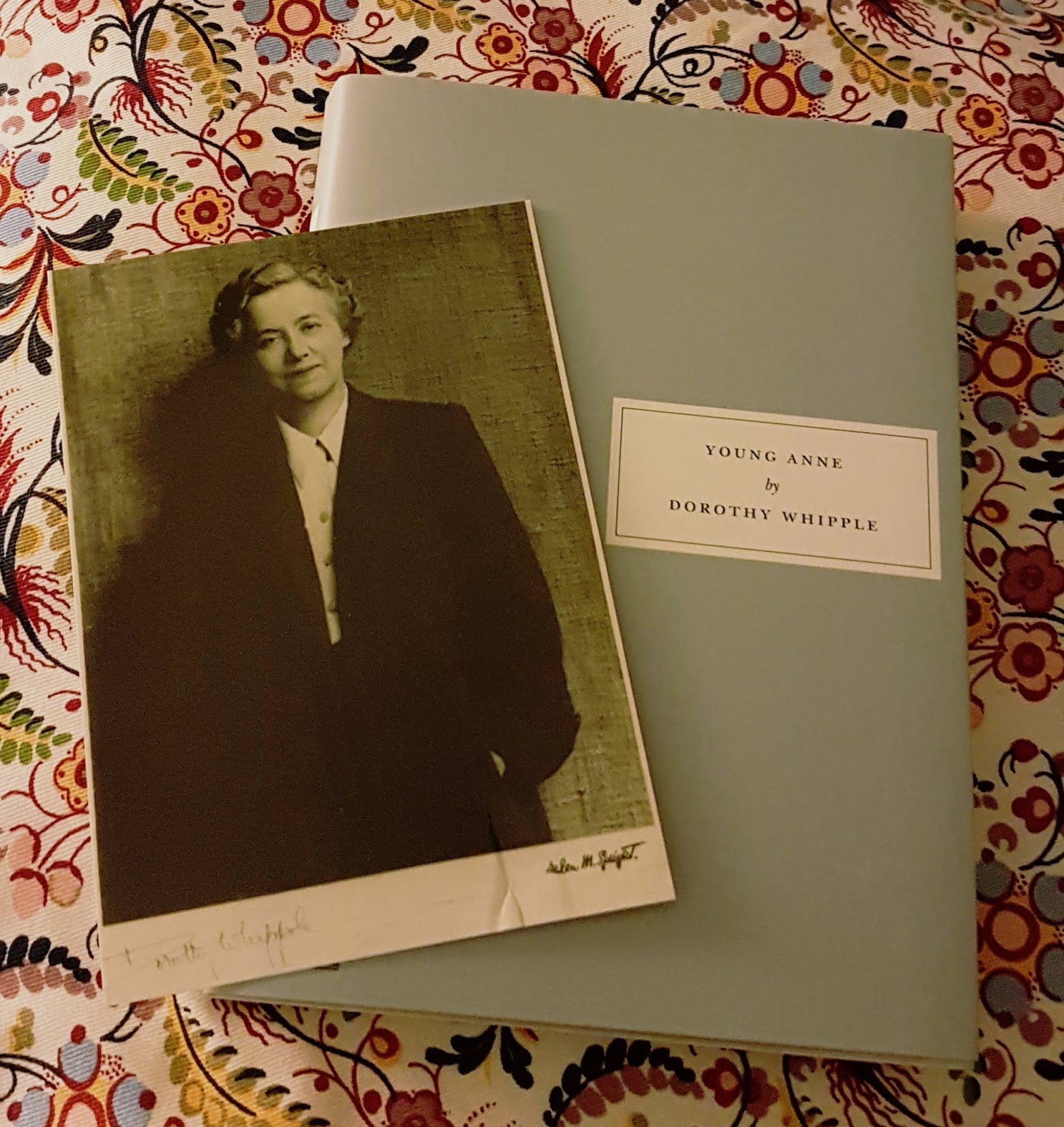
Young Anne


There is something bittersweet about reading Young Anne by Dorothy Whipple (one of the recent reissues by Persephone Books). On one hand, it’s a Dorothy Whipple so you know you’re in for a treat. But on the other hand, it’s the final Dorothy Whipple left for Persephone to republish so now the final page has been turned and… no more new Whipples. I am bereft!

For their final Whipple, Persephone have gone back to the beginning with Dorothy’s first ever book. Originally published in 1927, Young Anne is a clearly autobiographical book about Dorothy’s own formative relationship with the real-life George Owen who was killed in World War One. And as a tribute, the man who has stolen Anne’s heart is also called George. Which is a name the character dreams about calling her son, should she ever have one.

Young Anne follows the first 20 years or so of Anne Pritchard’s life, from girlhood to marriage. The only daughter in an Edwardian family that favours sons and practices Victorian values of showing the children no affection whatsoever, headstrong Anne is packed off to a convent in the hope it will quieten her down. Instead she becomes infatuated by the romanticism of Catholicism and the subject of young girls’ crushes. When her emotionally detached father dies and leaves Anne and her mother destitute, Anne is taken in by her witch of an aunt while her mother moves on rotation from one relative’s spare room to another, dependent on the kindness of others. The only constant and comfort in Anne’s life is the family’s maid Emily, who has known her since she was a baby.

Seeking financial independence, Emily defies her austere aunt and enrols on a secretarial course before taking an office job where she finds her husband. But all of this happens around the real heart of the story, and that is Anne’s love with her friend’s cousin George Yates. George is a bright, kind and sparky young man from a poor family, and he has a huge chip on his shoulder about his lack of wealth and his lower status than Anne’s. But Dorothy’s descriptions of the building love and passion between the two is convincing and when Anne suddenly breaks it off with George, the reader is left as confused as he is.

But being Dorothy Whipple, nothing is straightforward and love cannot run smoothly. While Young Anne has all the hallmarks of a fledgling novelist finding her voice, the distinctive sound of Dorothy Whipple can easily be heard in this compelling novel. While a Whipple can never be called a challenging read, they are always compulsive and I enjoyably sped through Young Anne in one weekend.

There’s a lot going on in Young Anne. While ostensibly a novel about young love and the influence it can have on the rest of your life, this is also a novel with sparks of feminism (Anne can’t understand why she must fold sheets while her brothers need not; she is frustrated at how hard it is for young women to be trained for employment; her mother becomes a burden to others when she is left widowed and homeless). But more than anything, this is evidently a story about Dorothy Whipple’s own love for George Owen.

Friday, 6 April 2018

'Art and Suffrage'


Anyone with an interest in the history of women's suffrage in the UK will surely have come across historian and writer Elizabeth Crawford. Her two key books, The Women's Suffrage Movement: A Regional Survey and The Women's Suffrage Movement: A Reference Guide are indispensable to anyone interested in researching the women who campaigned in their own area... and were absolutely essential tools when researching my own recent book, The Women Who Built Bristol (to which Elizabeth also generously contributed several entries).

As well as these reference guides, Elizabeth has authored a number of other books, and the one that I recommend to absolutely everybody (if you're only going to pick one) is Campaigning for the Vote: Kate Parry Frye's Suffrage Diary, which I wrote about a few years ago upon publication. You can also watch a video of Elizabeth talking about Kate here (and see the back of my head throughout, sorry about that!).

Now, published in February to coincide with the centenary of when (some) women received the vote, Elizabeth has published Art and Suffrage: A Biographical Dictionary of Suffrage Artists


This beautiful, fully illustrated new book covers the lives of more than 100 suffrage artists (mostly women), many of whom I did not previously know about although their artworks were largely familiar to me. So it was truly fascinating to read the stories about the people who created these important pieces of suffrage propaganda and merchandise, and to read about how these artworks came to be and the reasons behind them. It adds a whole new level to my understanding of the imagery of the suffrage campaign. Because, of course, it is hard to imagine a political campaign that was more visual than the suffrage one.

You can visit Elizabeth's website here, and her publisher's website here to buy the book. 


Monday, 2 April 2018

'Mollie on the March'

'Mollie on The March' by Anna Carey


Hurrah, Mollie Carberry is back! You may recall that last November I wrote on the first instalment from YA writer Anna Carey about the schoolgirl suffragette in Dublin. The good news then was that Anna was close to finishing the second book in the series, and the better news is that now that book - Mollie on the March - is published. 

Picking up where The Making of Mollie left off, Anna reunites us with our teenage shero who is still fired up from secretly painting a postbox with suffrage slogans alongside her best friend Nora. This time, Mollie and Nora are keen to be even more militant in their actions and to join Mollie's big sister Phyllis and her suffragette friends on marches and demonstrations when Prime Minister Asquith makes his visit to Dublin. Except, in the new book, Mollie and her crew get into far bigger and more daring but exciting scrapes.

Adding a fly to the ointment is Nora's wretched goody-two-shoes cousin Grace, who we met in the first book as a nuisance at school. This time, Grace has come to stay with Nora for the summer... and Nora and Mollie are determined not to let Grace find out about their suffrage plans for fear she will stop them taking action. Although there's a new side to Grace that readers may not be expecting...

As before, Anna uses real historical events as the basis for her storytelling, as well as peppering a few real-life characters into the background. And as before, the overall effect is one of magically capturing the moment and enveloping her reader in the scene.

I hope we see more books about Mollie and Nora in the future. Bravo, Anna!


Sunday, 25 March 2018

'Tory Heaven'

Tory Heaven by Marghanita Laski


Also going under the title of Thunder on the Right (and inexplicably as Toasted English in the US), this 1940s British political satire by the versatile writer Marghanita Laski has finally been rescued from its long-out-of-print status by Persephone Books.


Laski will be no stranger to regular Persephone readers, because the publisher has reprinted four of her other novels prior to Tory Heaven - which is published in April 2018 (and for which I was fortunate to receive an advance copy). From the haunting ghost/horror story The Victorian Chaise Longue to the wartime social commentary of To Bed With Grand Music, it is clear that Laski was a writer who was more than capable of turning her pen to whatever genre she preferred… and then layering it with nuance.


Tory Heaven was first published in 1949 and is a satire of the British class system. It follows a British refugee, James, who is rescued from a South Sea island in 1945. Our hero makes his way back to Britain where he is met by a very different country to the one he left several years previously: the class system has now been reinforced with a rigidly enforced categorisation of people into As, Bs, Cs, Ds or Es. With As being entitled to every luxury and privilege known to mankind, and Es being treated as barely human.


Fortunately for James, his public schooling and charmed upbringing has him designated as an A - but he quickly realises that for all the good food, comfortable lodgings, obsequious staff and available women thrown at him, he has lost his right to independent thought and action in this Conservative utopia. Upon visiting his family (who are also As), James is horrified to see them uncomfortably dressing formally for dinner and ploughing their way through endless courses of stodgy British fare because this is what their servants expect… and if they veer away from tradition then spies may well report them to the authorities who will strip them of their status.


In this way, it is easy to make a topical comparison to Margaret Atwood’s 1985 dystopian novel The Handmaid’s Tale, where every home in the new kingdom of Gilead is at risk of housing a secret ‘eye’ for the government who can report back on regimental slips in the home and cause the offender’s hand to be amputated… or an even worse punishment. The class battles in Tory Heaven also reminded me of Henry Green’s 1939 realist/modernist novel Party Going, which claustrophobically hones in on a group of toffs who are stranded at Waterloo Station after fog shuts down the transport system, so they decamp to the railway hotel and behave abysmally as their entitlement and self-perceived authority over one another comes to the fore. In both cases, the upper classes are shown, as in Tory Heaven, to indulge only their own needs and to see the lower classes as nothing more than animate objects that exist to serve their whims. It also called to mind Miss Ranskill Comes Home by Barbara Euphan Todd (also reprinted by Persephone), where our once shero returns to an England in the grip of WW2 and finds it an utterly alien existence.


In Tory Heaven, James realises he is in a waking nightmare because his every action is monitored and there is a script he is expected to follow for both his words and actions… and woe betide anyone who falls out of line with the expectation for their class.


The gender roles are also rather horrifying in Tory Heaven, just as they are in The Handmaid’s Tale. When James first arrives in London, he stays in a plush hotel and finds that along with hot water, fresh linen and delicious food, he is also supplied with a beautiful naked woman in his bed to cater to his desires. The Ministry of Social Security (ironically, a far cry from our contemporary understanding of social security) is keen to source bachelor James an eligible debutante for his wife… rather than allow him to marry his own choice of bride, Penelope, who, despite being an A, is also over 30 and therefore not marriage material. And conversely, while men and women who are As lead a luxurious if stifling life, their counterparts in the E class are degraded beyond belief: the only profession deemed suitable for E class women is prostitution.


Laski’s light-hearted style of writing make this an easy and enjoyable read but this certainly doesn’t detract from the message she wants to make. And it’s not a stretch to imagine that Persephone has chosen 2018 in which to reprint this class satire, with its roots in the effect war has on the surviving nation. The parallels readers can make between the Britain of 1949 that Laski writes about and the Britain of 2018 that we inhabit today are, sadly, plentiful. And remain shameful.