Pages

Tuesday, 21 February 2012

Suggs at St Georges, Bristol


You know Suggs, right? The lead singer out of Madness, those genial, jovial, cheeky Lahndan nutty boys. Yep, him. Considering the legacy of Madness, it’s impressive to remember that during their original five or so years in the 1980s, they notched up a whopping 14 top ten hits. That’s not bad work. Although you’d be forgiven for thinking they never went away – Madness had their first farewell concert in 1992… and have continued to perform farewell concerts several times a year ever since, and released an album of new material in 2009!

But in between all that, Suggs has tried to forge a career independent of the other six band members. He’s tried all sorts of things over the years: he presented karaoke show Night Fever on Channel 5, he had a cameo in The Edge of Love, and he’s had a chat show on ITV1. Oh, and he’s written a book, too! But the thing people love him for most of all is being Suggs out of Madness.

His show tonight, Suggs: My Life Story, sees him take to the stage in St Georges, with only a pianist for company, and stand beneath the hall’s imposing altar piece to deliver a music hall-esque performance of memories and jokes, while every now and then breaking into a few bars of a song. It’s a simple enough set-up and it suits him very well – with his Cockney accent, his likeable character, his natty suit. The only problem is it feels a little too scripted, and a little too much like Suggs is simply going through the motions. There’s nothing very natural about his speech, no sense of ad libbing or chancing his luck. But it comes over that Suggs seems like a top bloke, and the audience in the sold out hall clearly love him.

Suggs starts with a monologue about waking up on his 50th birthday to find his beloved cat has died, which takes him on a journey to his mum’s in Soho to find out more about the dad he never knew. This gives Suggs the opportunity to duck backwards and forwards through time to fill in the gaps – although I couldn’t help but wonder why he didn’t simply go on BBC1’s Who Do You Think You Are? to find out what he needed to know. 

His speech is peppered with snippets of songs, some brief, some longer, and mostly his own. Over the evening, we’re treated to bits of Lola, Baggy Trousers, Embarrassment and, of course, a wonderful rendition of It Must Be Love to close (which is my favourite ever love song, fact fans). The music is lovely, and what with it being the thing that made Suggs famous in the first place, it’s clearly what the audience most wants to hear.

My highlights of the show, musical moments aside, were his two mime gags: one of himself miming how he didn’t mine on Top Of The Pops, and another of himself miming using an old-fashioned phone box. Those were both priceless moments of comedy. Although I hope it’s not reading too much into it to observe that they were both silent moments.

While much of Suggs’ raconteur-style musings sound a little stilted, he’s a decidedly warm and charming host, and to spend a few hours in his company was a comfy pleasure. Heck, he got a standing ovation at the end!


To see where else Suggs is performing, please click here.

To see what other shows are coming up at St Georges, please click here.

Monday, 20 February 2012

Architects, Angels, Activists and the City of Bath


Hot off the press is Canadian academic Cynthia Hammond’s respectful appreciation of the unacknowledged work of women over the past centuries in creating the city of Bath as we know it - Architects, Angels, Activists and the City of Bath 1765-1965: Engaging with Women’s Spatial Interventions in Buildings and Landscape (Ashgate, £65). 

Divided into three sections, the book covers the lesser known female architects who are largely forgotten in the wake of men like John Wood the Elder and John Wood the Younger; a section on the representation of angels in the city, remarking on the relative absence of female angels at the famous Abbey and affecting to remedy this with a performance piece; and lastly a beautifully detailed section about the trampled Suffragettes’ Wood at Batheaston (see also this post from a few weeks ago).

While the whole book is fascinating, my main interest is the third section. I’d vaguely known of a Suffragettes’ Wood in Somerset for some time, but it was only after making contact with Dan Brown in early January that I gained access to his book (compiled with Hammond last year), and found long-lost books by Victoria Nimmo (Women of Violence, 1985) and Beatrice Dobbie (A Nest of Suffragettes in Somerset, 1979) in Bristol and Bath Libraries.

For those who don’t know about the Suffragettes’ Wood, please have a quick read of my previous post. And once you’re up to speed, revel in the fact that Hammond uses this book to take the research a step further and bring it up to date. Brown and Hammond’s previous book is more of a historical analysis and document, stating what happened and cataloguing as many of Colonel Blathwayt’s photographs as possible. 

What Hammond now does is retrace the steps of the suffragettes around Batheaston and Eagle House, and in the process she finds two (now elderly) women who used to play in the Suffragettes’ Wood as children, which enables Hammond to construct a detailed map locating where all the bushes and trees would have stood, and the location of each of the photographs.

What struck me the most was the amazing task Hammond undertook in attempting to rebuild the arboretum as far as humanly possible, given the fact the site is now a housing estate. She bought trees and conifers, and delivered them to all the residents of Eagle Park, inviting them to plant and care for the trees, and letting them know about the history of the site upon which they now live. 

Hammond’s respect for this task was extremely moving, and showed through as an intensely powerful gesture of support for the history of women in the United Kingdom. However, is it not shameful that we needed a Canadian woman to do this for us – was there really no one in England for cared enough to ensure the memory of the arboretum never died?

Hammond is rightly recognised as an authority on this subject: she has given papers about this at Bath Spa University, and written elsewhere about the arboretum. I hope her work never ceases, and that she continues to turn over more stones to unearth yet more amazing stories about this trampled site. Although, with it being 113 years since the first trees were planted at Eagle House, and about 40 years since the bulldozers demolished history, there cannot be many people alive who still have living memories of the arboretum. Which makes it all the more wonderful that Hammond managed to find two women who could share their memories with her. I can only image how her spine must have tingled as Hammond listened to these women speak – because my spine tingled when I read what they had to say.

Saturday, 18 February 2012

Without Judy Blume, I’d know nothing about life


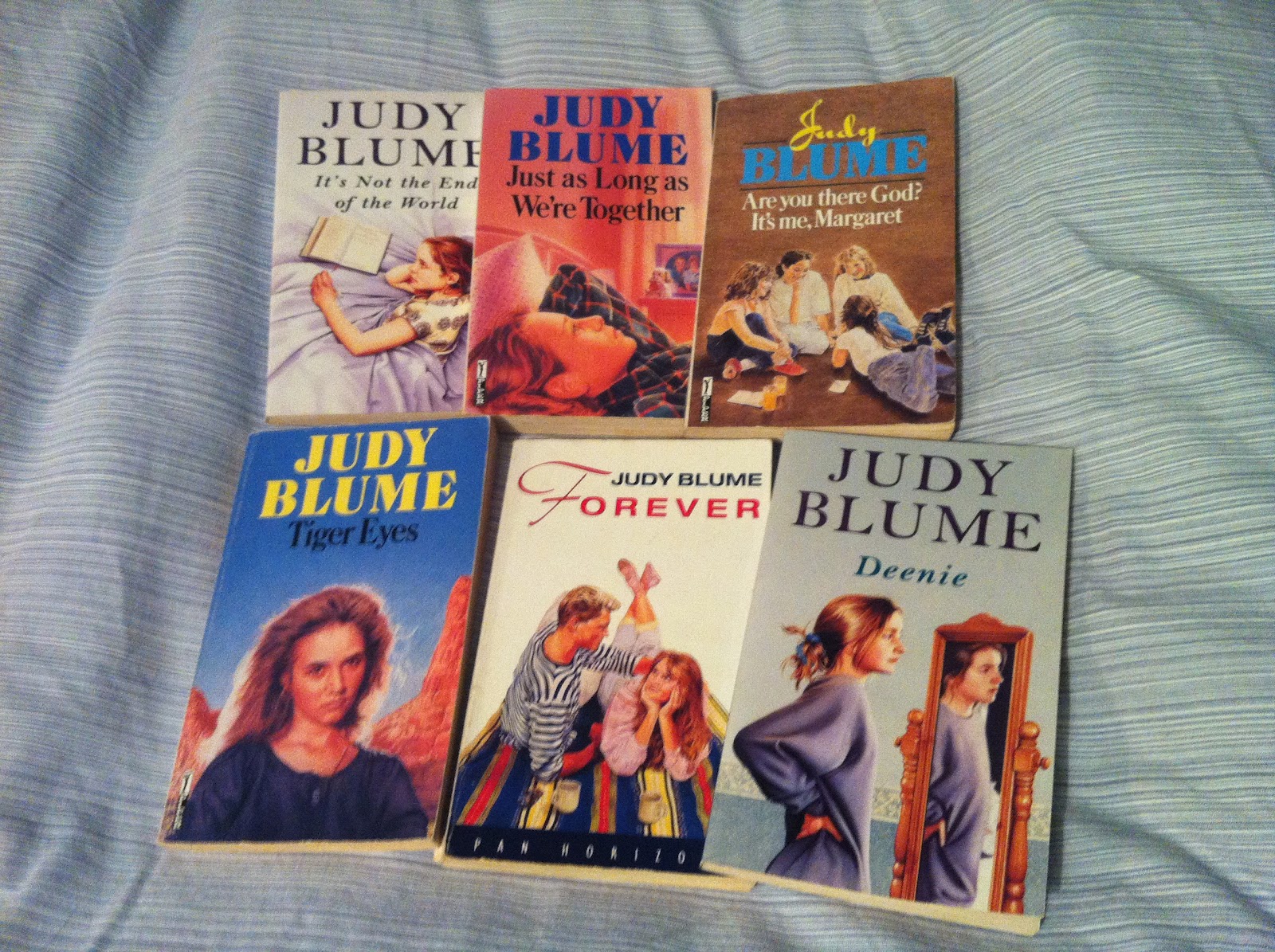
My much-loved Judy Blume collection
There is no other teen novelist who had such an impact on me as Judy Blume. And based on some Twitter conversations last night, I’m not alone in my enduring respect and love for Judy.  (Would it be too familiar to call her Auntie Judy?)
This came about after my mum yesterday produced a box of my old books. Among the battered copies of Jill Murphy’s Worst Witch series, Snoopy novels, and Adrian Mole diaries (held together with peeling Sellotape) were a handful of extremely tatty and well-thumbed Judy Blume novels.
It was like meeting up with old friends, ones who had held my hand through those confusing pre-pubescent years and early adolescence. There was Deenie, who endured a crippling back brace before facing the fear of her first period. And here’s Margaret, who confides in God about her worries about periods and her parents’ marriage. Don’t forget Stephanie, who had to handle the problem of juggling two best friends. And then there was Karen, who felt so alone after her parents got divorced; and Davey who was grieving for her father. But never forget Katherine and Michael, whose love was not to last, err, forever.
It surprised me to find just the six tatty paperbacks. Where were all the others? Judy wrote prolifically in the 1970s and 1980s and I’d read every one of her books. And then I realised that while I’d devoured everything Judy wrote, the act of owning books was certainly not taken for granted back when I was 11/12 and at the height of my Judy reading. This was before I had a Saturday job and my own money, so any books I owned came from birthday or Christmas presents or book tokens. Everything else was found in the school or public libraries, or borrowed and swapped with friends. In school holidays, we’d even post paperbacks to each other. There’s something very pleasing about remembering this early absorption in reading, and for it to be a shared pleasure – one that was not ordered by teachers but that was entirely self-generated, and one that was (at times) irritating to teachers and parents, who knew there were sometimes controversial topics in Judy’s books (periods, masturbation, bullying, racial abuse, parental divorce, the Holocaust, teenage sex…). 
Aged 11, I spent a year diligently scribbling in my Judy Blume Memory Book.
Needless to say, it is extremely embarrassing to read now.
I really don’t think it would be overstating the matter to say that Judy contributed to the bulk of my early education about puberty and growing up. Remember, I was reading Judy’s books in 1989/1990, while attending a convent school staffed by joyless Belgian nuns, and the internet was but a twinkle in someone’s eye. Pretty much all I knew about puberty came from the solitary school visit by the Dr Whites nurse: our class was not told the reason why our timetabled lesson was cancelled and we were being shepherded into the formal assembly hall, where a middle-aged nurse proceeded to show us some confusing watercolour pictures of cross-sections of the female body (minus head or legs), before issuing us all with a bag of leaflets and Dr Whites samples. Couple this with the solitary lesson about periods from our biology teacher, which involved her getting a Tampax out of its wrapper, and putting it in a glass of water to show us how big it would get. But at no point telling us why we would need such a scary looking thing, or even where we should put it. Honestly, I can only hope that sex education in British schools has progressed a lot in the past 22 years. And don’t get me started on the sex education video we were shown (in the school library, which was sealed off with ‘Do Not Enter’ signs, already making us aware that sex was a shameful act, a fact that was aided by the TV being positioned underneath a crucifix), which was filmed in the 1970s and involved some extremely hairy, naked people playing volleyball on a beach, and a starchy male scientist in a studio talking incomprehensibly about things like ‘penises’ and ‘vaginas’ (what were they?!).
So, thank heavens for Judy Blume. Thank heavens she wrote Are You There God? It’s Me Margaret and Deenie, to explain about periods and that they were perfectly normal, but that it was OK to be a bit confused about the whole thing. And thank heavens she wrote her books in such an accessible way that made you sure that here, finally, was an adult who understood what it was you needed to know, and whom your friends also read.
Woo! Judy wrote to me in February 1990...
I chose to overlook that it was a photocopied form letter.
But Judy didn’t just teach me about growing up, she also made me aware of a whole world outside of the tiny Somerset village I grew up in. Judy’s books were all set in her homeland of America. To 11-year-old me, there seemed as much chance of me going to the moon as to somewhere as exotic as America. After all, this was a country with a whole other dialogue! Judy’s books were peppered with words and phrases I didn’t understand, and needed to find out the meaning of. What were ‘cooties’? What was ‘the den’? What was Scotch tape? There were so many examples that made America seem way more glamorous than my provincial English existence. Why didn’t my school have a ‘homeroom’? Why didn’t we have a schoolbus? Or Halloween parades? What the heck was a ‘Y’? Looking back now, it’s terrifying to know that all the Jewish references were also alien to me – with my Catholic education and small-town English upbringing. It’s embarrassing to admit that. At my school, we had no knowledge of any religions outside of Church of England or Catholicism. As far as we knew, there were no other options. And since WW2 wasn’t covered in history classes, there was no need for us to know about Judaism. This alone is a terrifying lack in 1980s/1990s schooling.
What’s my favourite Judy book? It’s Deenie, the first book of Judy’s I read, and probably the one I’ve read more than any others (first accessed from the school library – but removed after the nuns discovered it had references to periods and masturbation). But Are You There God? It’s Me Margaret holds a strong place in my affections (a Christmas present, and a book I fondly remember while lying on the sofa with Neighbours on). And it’s impossible to overlook the significance of Forever on my young mind (bought with Christmas book tokens in WH Smith). I’m sure that book is responsible for many generations of women who remain unable to snigger when they hear the name Ralph – maybe Forever is single-handedly responsible for the decline in popularity of the name Ralph?!
Has Judy been sainted yet for her services to education? Because she should be. The very fact that so many of her books were deemed controversial or even placed on banned lists (here’s an article by Judy that explains more about this) is testament to the fact that her books were honest and true accounts of real topics that patriarchal society feared it would be damaging for young girls to know about.
Thank you, Judy, for writing all those important books, and for filling in the many glaring gaps in my education where my schools failed me. And thank you for introducing me to America, a land I still think of as romantic and exciting.
--
Here’s a powerful article in The Tablet about Judy’s Holocaust novel, Starring Sally J Freedman As Herself.
And here’s a Huffington Post article about Judy’s most controversial books.

HG Wells and the suffrage novel


First published in 1909, Ann Veronica is HG Wells’ novel addressing his support of women winning the right to vote and thereby gain their independence from men. And it’s a strange one.
Our heroine Vee is a 21-year-old, middle-class science scholar who lives with her widowed father and spinster aunt in Suburbia. She dreams of escaping her father’s overbearing control over her, and of taking up with her Bohemian friends… who have introduced her to the idea of women’s suffrage.
Ann Veronica is a book in two parts. In the first half of the novel, Vee is painted as a naïve but impassioned young woman who is determined to get what she wants by any means. HG Wells creates her as a malleable vehicle for demonstrating to his readers how suffocated women are without the vote, and the subsequent right to live independently of fathers or husbands.
Yet the second half of the novel, as has been widely agreed in reviews, descends into a tedious romance bearing little relation to the first half, and causing the reader to care little for what scrape Vee has now found herself in, and whether she can win yet more people round to her manipulative way of thinking.
This was a curious book to read as I work my way through as many suffrage novels as I can manage, but I’m not sure HG Wells put as much time and thought into this as he did with his better known books. There’s every cynical possibility that Ann Veronica was simply an outing for him to express his (supportive) views about the enfranchisement of women.